Live Online Course: Primary Modern
Learn about history events during the modern times with a focus on the Muslim Ummah!
This course is designed for students in grades 3 and 4.
The course runs for 30 weeks, with 2 lessons each week.
This course is aligned with our Primary Grades Book 3 Early Modern.
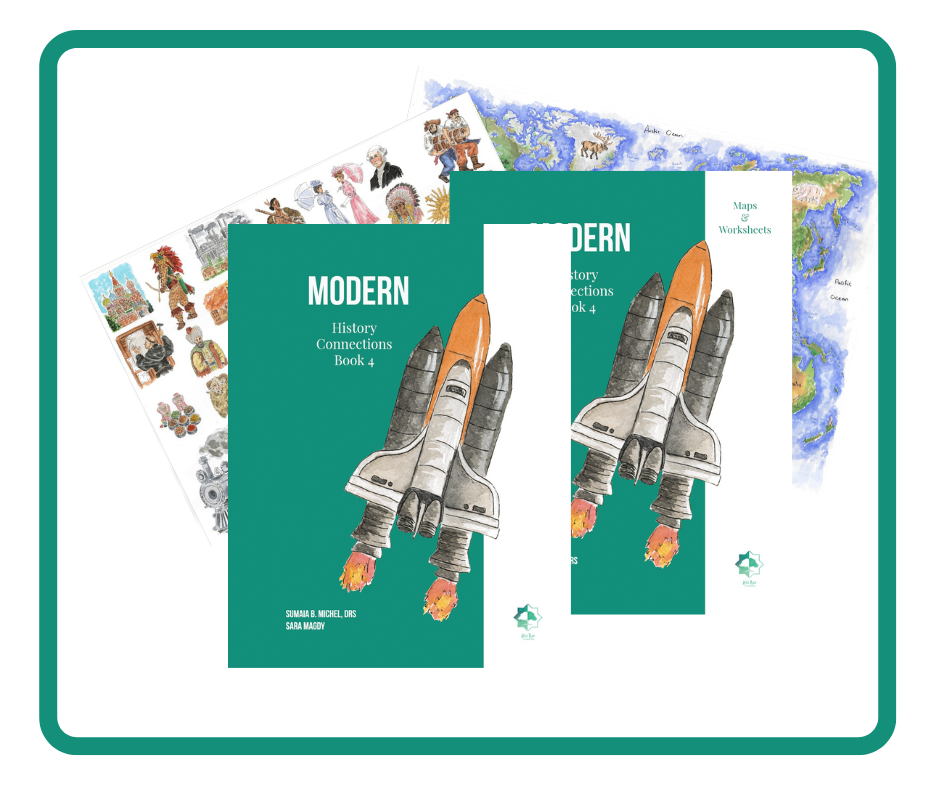 The Modern Era is a highly politicized era, and emotions can run high on many of the topics. We have attempted to give a balanced overview of the global history during this era, without losing our focus on what happened to the Ummah. The Ummah is globally spread out, with the highest concentrations of Muslims living in the Middle East. The Middle East is an area highly contested with many conflicting groups of people. The rise of concepts such as democracy, nationalism, development and industrialization, often have replaced the religion as the main driving force of forming communities, pushing the deen as such more to the background. Nonetheless, we will focus on what is happening in countries where the majority of people are Muslim, as part of our Ummah.
United States |
Australia |
|---|---|
Mondays & Wednesdaysat 1 pm PST Starting September 7th 2025 |
Tuesdays & Thursdaysat 6 pm AEST/AEDT Starting February 10th 2026 |
|
Download the schedule online history courses 2025 schedule .pdf
Download the academic calendar Academic Calendar 2025-2026.PDF
|
Download the schedule Australia online History Class Schedule 2026.pdf Download the academic calendar Academic Calendar Australia 2026.pdf |
We have limited seats available
Regular price
Lesson Link
About Lote Tree Learning - Read this first
Academic Calendar
How the book works
Preparing for teaching
Contents of the book
Talk to us!
How to assemble the posters
Download World Wall Map
Crescent Moon Poster
Location Map of New Nations
Inquiry Sheet
Materials Needed week 1
Location Map of South America
Inquiry Sheets
Materials Needed week 2
Extra resources week 2
Location Map of Africa
Inquiry Sheet
Materials Needed week 3
Extra Resources week 3
Location Map of the Civil War
Inquiry Sheet
Materials Needed week 4
Extra Resources week 4

History in Context
Learning about what happened in the past is essential to understand what is happening in our current society. Giving children a sense that they belong to a larger community is essential for their sense of belonging. Learning about a proud heritage teaches children self-esteem. Infusing this knowledge with Islamic concepts, teaches them good character. Mastering 21st century skills allows them to function in modern society.
Our History Connection series covers the ancients all the way up to the modern history and current issues. This series is intended for grade 1 through 8.
Every year students will take a chunk of this history. In the first book, students will cover from Creation to about 500 C.E. In the second book, they will cover from 500 C.E. until about 1650 C.E. The third era will cover from 1650 C.E. until the Industrial Revolution, approximately 1850 C.E. The last era, the Modern Era, will cover from 1850 C.E. until our current day.
All Eras have Islamic History integrated within global history, with more attention and time spend on important topics in the history of our Ummah.
The four books in this curriculum are consecutive, not only in chronological information but also in building skills.
Each curriculum covers a full year of 30 weeks. The curriculum is gradually progressing in skills and knowledge and is packed with activities and extra resources. Islamic concepts and knowledge are integrated as part of the history content.
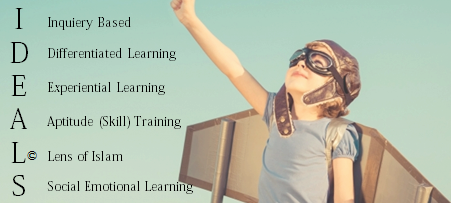 Our unique approach to learning is summed up in the acronym IDEALS, which covers several methodologies and skills we believe should be covered in all educational programs,whether for primary students or adults. IDEALS stands for Inquiry Based Learning, Differentiated Learning, Experiential learning, Aptitude Training, Lens of Islam, and Social-Emotional Learning.
Inquiry-based learning is an approach to learning that emphasizes the student's role in the learning process. Rather than the teacher telling students what they need to know, students are encouraged to explore the material, ask questions, and share ideas.
Differentiation means tailoring instruction to meet individual needs. Differentiation is a framework for effective teaching that involves providing all learners a range of different avenues for understanding new information.
Experiential learning is the process of learning through experience, and is more specifically defined as "learning through reflection on doing".
Aptitude Training determines how well-equipped students are to make good decisions and solve problems in their academic, professional and personal lives. Skills are the building blocks that allow students to apply the knowledge they acquire in an academic context to real world problems and situations.
Lens of Islam integrates Islamic knowledge into elements of the academic program in order to provide students with an Islamic lens to view the world and to create connections between the deen and the world at large. Viewing the world through an Islamic lens will increase a sense of purpose and meaning, and allows students to foster their Islamic identity and live with integrity.
Social-emotional Learning is the process through which students acquire and apply the skills necessary to manage emotions and social relationships. According to Goleman, social-emotional intelligence “emerges as a much stronger predictor of who will be most successful, because it is how we handle ourselves in our relationships that determines how well we do once we are in a given job”.
Classes are held twice a week. Classes are usually 1 hour long but may extend to 1 hour and 15 minutes when there is a longer activity.
The course runs for 32 weeks, divided over the year into blocks of roughly 5 to 7 weeks. For more details on dates of breaks and holidays, please see the academic calendar, downloadable above.
Yes, it is a one-time payment. We do not offer monthly payments or installment plans.
The course integrates Islamic concepts into global history. All of our courses include Islamic history within a global context, with greater focus and time spent on key events in the history of our Ummah.
All materials are available online. You will need to print maps and worksheets before each class. If you prefer to have a physical book, you may purchase printed materials from our shop.
Students do not have regular homework, but they may occasionally have activities to complete between classes.
Teachers handle all instruction and explanations. You may be asked to assist with assembling the posters in the beginning of the course, but otherwise, you do not have to be involved in the teaching process. We ask that you ensure your child is seated in a quiet place, preferably wearing headphones. You will need to log in to the course page before class to check which materials are required. We keep materials as simple and easy to access as possible. It is important that children have their materials ready before class so they can participate in activities that support understanding and make learning enjoyable.
You will receive an invitation to the ClassDojo application, where you can communicate directly with the teacher and receive updates related to the class or your child.
Classes are recorded for quality assurance purposes. However, to protect the privacy of the teacher and the students, we cannot share recordings.

Learn about the Prophets (as) within the Global Context!
$669

Learn about the Seerah and Muslim empires that followed within the Global Context!
$669

Learn about Muslim Empires within Global Context!
$669

Learn the Prophets' Stories within Global Context!
$669
Subscribe to the mailing list and receive the latest updates